Social Ties in Animal Politics: Mutuality Beyond Humanity
discussing the possibilities of multispecies mutualism
discussing the possibilities of multispecies mutualism
Blog, Health at Home, Health in Conservation, Health in Diets, Health in Therapeutic Practice, Practices, Representations, Theories, Updates
Key Contact
On September 8th and 9th, the Multispecies Mutualisms Project co-sponsored (alongside the Mind Association) the conference ‘Social Ties in Animal Politics: Mutuality Beyond Humanity’.
Scholars and practitioners from across the UK, Europe, and North America came together to discuss the possibility of multispecies mutualism. While the majority of talks approached this theme through the discipline of political philosophy, there were contributions from veterinary ethicists, philosophers of biology, practitioners, and more besides.
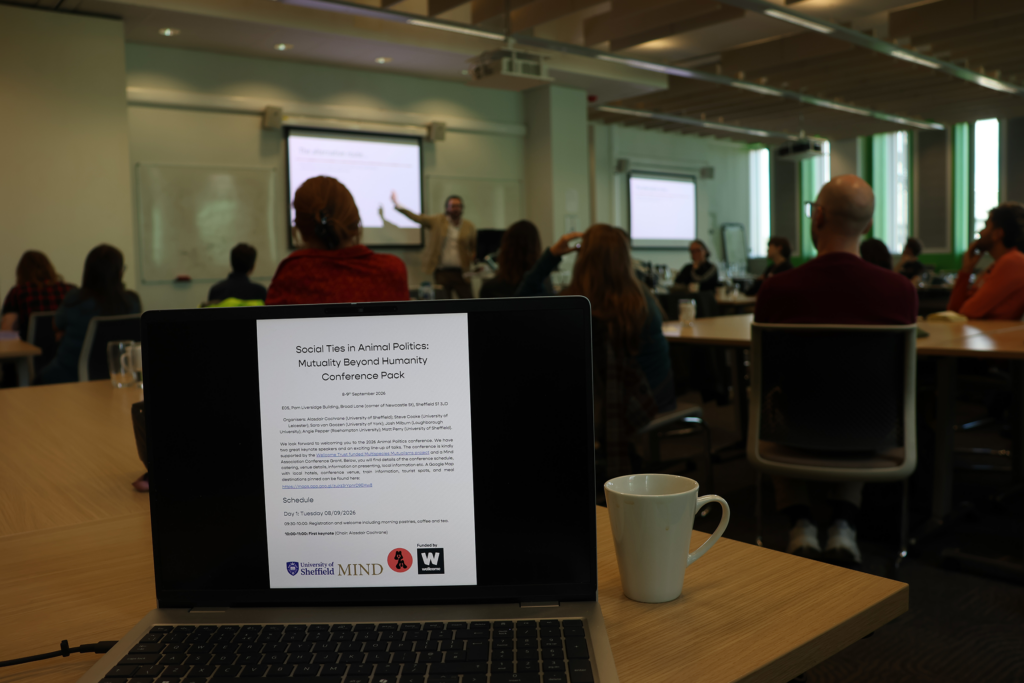
The conference was the latest in a longstanding series of annual workshops organised by the animal politics network in the UK. The organising committee comprised Matthew Perry (University of Sheffield), Angie Pepper (University of Roehampton), Steve Cooke (University of Leicester), Sara Van Goozen (University of York), Josh Milburn (Loughborough University) and Alasdair Cochrane (University of Sheffield).
Social Ties in Animal Politics sought to investigate the everyday reality of coexistence with animals by exploring the diverse range of social, political, and institutional relationships between us. Some talks focused on the conceptual resources we have available to us to make sense of such relationships (toleration, conviviality, representation, the hivemind, home, rootedness, contract, rights). Others examined specific practices of purported mutualisms (horse-riding, donkey assisted activities, pet-keeping, disaster planning). Still others looked at specific species of nonhuman animal and their mutualistic behaviours (Great Tits, bees, donkeys).
Talks also tackled the profound challenges to any possible vision of mutuality beyond humanity. Consistent themes in this regard included the inescapable asymmetries in power between humans and animals, and the significant communicative and epistemic barriers between species.
The conference was opened on each day by two keynote lectures. In the first, Frauke Albersmeier, University of Munster, discussed ‘Tolerating Animals: Probing the Lower Limits of Interspecies Existence’. This was an incredibly important reminder that the vast majority of interspecies relations are far from mutualistic; and if we are to aim for anything resembling the latter, there is still much work to be done in simply tolerating (refraining from interfering with) nonhuman animal others.
In the second keynote lecture, Steve Cooke, University of Leicester, discussed ‘Animal Cultures as a Matter of Political Morality’. Summarising the impressive empirical studies of the social lives of animals – focusing down specifically on Great Tits – Steve explored their normative significance. In so doing, he made a powerful but nuanced case for respecting the cultural lives of animals.
Overall, the conference provided incredibly useful insights for the Multispecies Mutualisms Project, with helpful new tools for its conceptual interrogation, alongside rich engagement with specific real examples of mutualism in practice. We really look forward to keeping the conversations going over the forthcoming years.