Rethinking ‘win-win’: Multispecies Mutualisms panel at EASST 2026
What happens if we start with questions of harm and exclusion, rather than ending with them?
What happens if we start with questions of harm and exclusion, rather than ending with them?
Blog, Case Studies, Health at Home, Health in Conservation, Health in Diets, Health in Therapeutic Practice, Practices, Theories, Updates
Key Contact
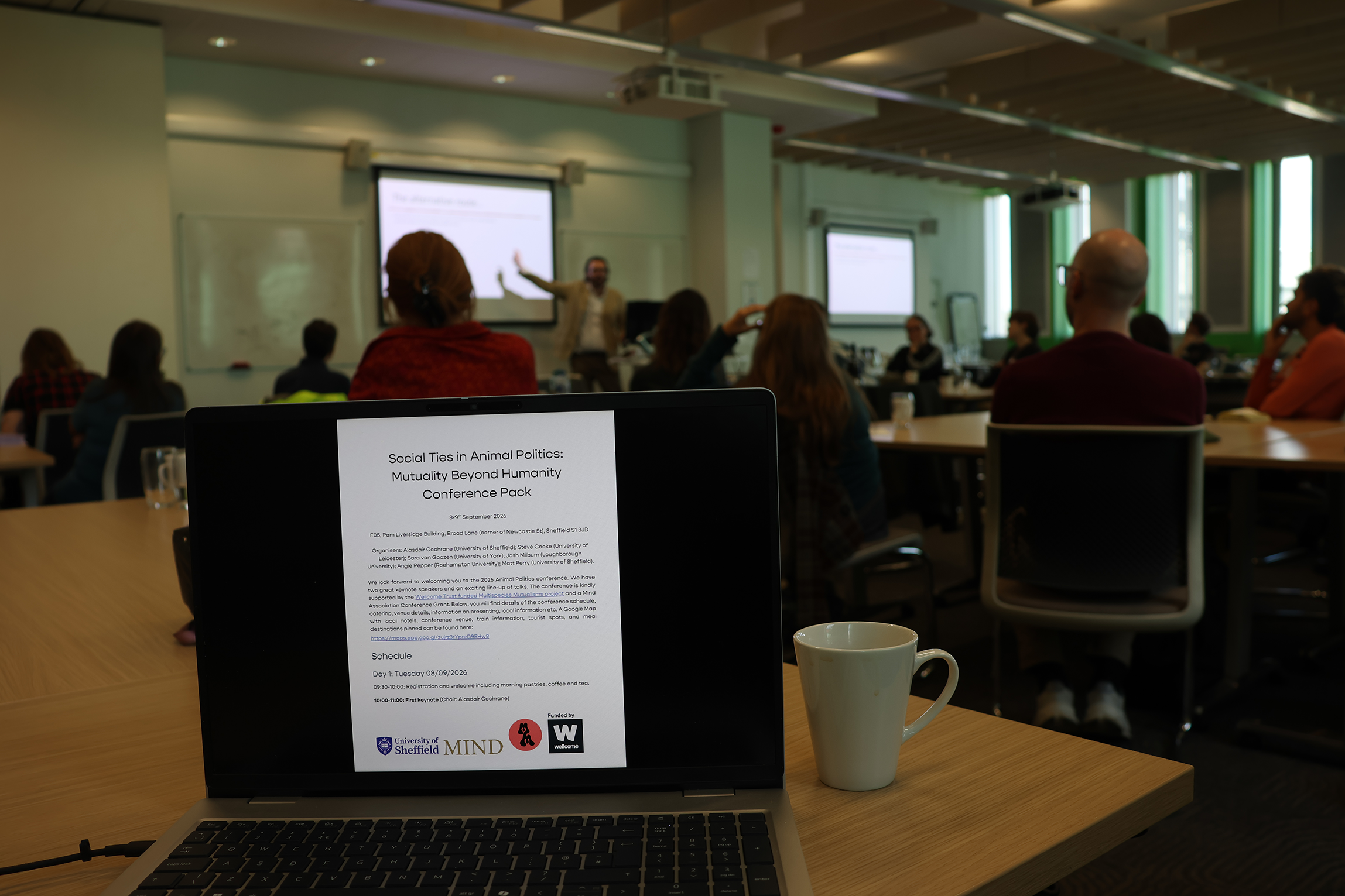
This question was at the heart of a three-panel stream convened by Eva Haifa Giraud at the 2026 European Association for the Study of Science and Technology (EASST) conference. Bringing together an international group of speakers from the field of Science and Technology Studies (STS), and beyond, the panel explored the complexities behind claims that human-animal relationships can produce ‘win-win’ health benefits for all involved.
The Multispecies Mutualisms team were especially keen to generate debate around these issues at EASST, due to STS being the field from which some of the most influential theories and frameworks for conceptualising human-animal relationships have emerged. For instance, thinkers such as Karen Barad, Bruno Latour and – perhaps most influentially of all – Donna J. Haraway have had influence well beyond STS and shaped understanding of multispecies relationships across fields such as animal studies, the environmental humanities, and more-than-human geographies. This influence is illustrated by the ubiquity of ‘entanglement’, ‘flourishing’, ‘co-becoming’, ‘response-ability’ and ‘nonhuman agency’ (to name some of the most obvious terms!) for understanding the dynamics of human-animal relationships. While this scholarship has been intellectually groundbreaking and ethically important, a conviction shared by many of the Multispecies Mutualisms team is that these approaches (or at least how these approaches are commonly applied) have their limits when it comes to addressing questions of harm and exclusion. We are still unsure what the alternative is, but finding new directions is one of the central aims of the project. Our ambition, in other words, is to develop a new theoretical framework (or frameworks) informed by our discovery research, in order to address urgent questions about who really benefits from relationships that are commonly presented as mutualistic. To this end, we invited other scholars to join us in exploring these questions in our conference stream “Multispecies mutualisms? Rethinking ‘win-win’ health entanglements between species”.
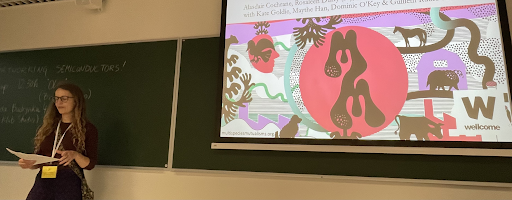
We already had high hopes due to the strength of the abstracts that people had submitted, but the depth and quality of papers exceeded our expectations. The energy and discussion in the (very full!) room across all three sessions also suggested that there is genuine enthusiasm for finding new intellectual pathways forward for multispecies mutualisms.
The first panel in the stream focused more squarely on human-animal relationships and featured presentations by Eva Giraud (who introduced the stream), Liam Healy and Mia Mai Symonds, Swad Bruneel, and Yamini Narayanan. The papers themselves examined topics including the power of speculative design to rethink the relationship between conservation and recreation at Sheffield’s Redmires Reservoirs (Healy and Symonds), ethical tensions in farm animal sanctuaries (Bruneel), and the role of animal labour in Indian brick kilns in reproducing human impoverishment (Narayanan).The second panel shifted context and focus to laboratories, microbes, and insects, and featured papers by Marianne Mäkelin and colleagues, Alžběta Wolfová, Paula Palanco Lopez, and Joana Formosinho. The presentations probed the limits of a ‘culture of care’ framework for governing animal laboratories (Mäkelin), how disease control can result in hierarchies not just across but within species (which determines who or what is considered expendable) (Wolfová), the challenge of moving beyond a ‘war on microbes’ (Palanco Lopez), and the need for new ways of thinking though the politics of the microbiome in an era of ‘microbiomania’ (Formosinho).
The final panel zoomed out to wider ecologies and species stories, with presentations by Rebekah Ciribassi, Joanna Tusznio and colleagues, and Maisie Tomlinson. Again, this was a rich set of papers and addressed themes such as the entanglement of ecotourism with settler-colonialism and militarisation (Ciribassi), how mutualistic relationships with certain privileged species – such as bees – can obscure other mutualisms (Tusznio), and the power (and dangers) of ‘species stories’ in determining how therapeutic human-animal relationships are understood and enacted (Tomlinson).
Several recurring issues and themes emerged across the panels. These included a shared sense of ‘concept fatigue’ with common ways of understanding mutualisms and the need for an alternative vocabulary (perhaps oriented around more challenging concepts such as antagonism and coercion). Another recurring question – which arose in relation to seemingly diverse topics, including farm animal sanctuaries, laboratory regulation, disease interventions, equine therapy, and human-pollinator relationships – was who gets to determine what a ‘good’ or ‘healthy’ life is for nonhuman beings and how are these narratives constructed? The risk of privileged mutualisms foreclosing other mutualistic relationships was also highlighted, as was the risk of affective relations with other species being instrumentalised. There were also a number of overarching reflections about which figures and empirical sites might be generative for moving beyond existing narratives, and which concepts are travelling back and forth between STS and the natural sciences (and the risks, as well as potentials, of this intellectual traffic). Yet, despite the critical emphasis of many of the papers (which we very much welcomed!), fleeting moments of hope also occurred throughout the stream, and raised questions of what inspiration could be drawn from hopeful moments without putting too much ethical weight on them.
Many of these themes were picked up in generative ways by Renelle McGlacken and Camille Bellet who acted as discussants at the close of the stream. The discussion offered an opportunity to think critically about what multispecies mutualisms look like in practice, how they can be conceptualised and researched, and what they might become in the future.
Renelle and Camille have generously agreed for us to share their commentaries below and we would like to thank them both for their generous contributions to the stream – as interlocutors throughout the three panels – and for allowing us to republish their thoughts here:
I wanted to open by giving my appreciation for the difficult work being done by all of the speakers. In designing, witnessing, describing, analysing, and qualifying the lives of humans and other animals in ways which are instilled with, what I take, as a wish for better. An advocacy. This is not easy work and your readiness to interrogate the tools used to do it, to reflect on whether they, and sometimes we being caught up in them, are up to the job, are, I think, reflective of a commitment to the issues at stake.
So, looking back to Mia Symonds’ and Liam Healy’s paper and their work in inviting encounters with wildlife whilst respecting boundaries, I wanted to highlight what they highlight, the importance of a “radical hesitancy, a stepping back, a doing nothing”, a curiousness which tries to refrain from co-opting. Their discussion of attending to antagonism and its suggestion, for me, of who may feel excluded and uncared for by care initiatives, evoked the partiality of care and the ways it both connects and divides.
Across the session on Thursday morning, I thought about ‘following the thing’ in different ways. Mia and Liam’s tracing and connecting with birds from a distance and the following of public signage, and resistance around it, back to co-create something that might connect rather than fatigue. In Swad Bruneel’s work, the complicated and in some ways “paradoxical” work of sanctuaries and their role in making possible alternative afterlives of animals typically reduced to ‘livestock’ and, perhaps even ‘socially dead’, to be more than this. Not only to live, but importantly to age. And finally, in Yamini Narayanan’s talk, the human and animal costs of brick production and the work of those who create the foundations of homes and lives. Listening to Yamini, I thought about the limitations of agency across positions and the playing out of shared, but not the same, experiences of suffering within uncaring systems. The heartbreak of “fleeting moments” of enduring tenderness amidst the reduction of life to labour. How the movement which guarantees that equids “will be worked” is also in brief instants spent on acts of care for one another, maybe reaffirming their togetherness.
In the second half of Thursday’s session, Marianne Mäkelin discussed ‘Cultures of Care’ around scientific animal use and the ways that affect is mobilised to structure relations in the laboratory space. As someone also interested in the uneasy position of care amidst harm in this area, I wondered about the tensions of care-full aspirations, the ways that animal use disciplines researchers and care staff, and how the interests of animals can be simultaneously prioritised and deprioritised.
Listening to Alžběta Wolfová’s talk about the monitoring of West Nile Virus, I considered whether attempts to control and dominate are reflections of a denial of relationality and of place in systems of shared, yet unequal, vulnerability. The practice here of noticing where and via whom the virus spreads driven by hierarchies of care.
In Paula Palanco Lopez’s talk on moving beyond ‘war’ and ‘friendship’ framings of relations with microbes in Finnish farms, I enjoyed the recognition of the microbes’ lack of interest in the farmers’ agendas, and the need for a “productive uncertainty” about the microbes to enable a “way of keeping going” with them. Calling back again to the value of a relation of hesitancy.
Then there was Joana Formosinho’s reflection when discussing microbial relations of how the “scale of attention” shapes our conceptualisation of a relation – whether it is seen as “unity or disunity”. Bringing to mind the need to remember the histories, the structures, the systems, that bring us to and continue to shape any intimate relations we focus in on.
In the final session, we turned again to the multiple roles of fences, with Rebekah Ciribassi’s talk on the White Seneca Deer living within a former US army base demonstrating the ways fences restrict, divide, contain, hide, as well as non-innocently preserve and protect. As Rebekah said, not only containing life but “selectively reproducing” it. Here, I also wondered how fences relate to cages and how we understand the differences between each.
Joanna Tusznio’s talk on conceiving human-pollinator relations beyond economic value posed the question of how we might stimulate relations with both presence and absence. Although pollinators may be the “most accessible animals we can meet”, Joanna asked how we can also encourage care through encounters with their absence. It reminded me of listening to longitudinal soundscapes of meadows in the UK and their power to render audible an increasing quietness, making loss noticeable.
And to end, Maisie Tomlinson took us through the tropes and tensions of equine-assisted personal development. Again, fences were at work, structuring human-horse interactions where horses were not ridden – but were still controlled and enclosed. Maisie highlighted the role of design in guiding the sessions, the force of prompting with ‘species stories’ that help define the animal and script the exchange. Listening to the importance of mutuality to participants who engage in these horse-human encounters, I scribbled the note: ‘interaction vs relationship – what happens when we parcel up moments of assumed connection?’, wondering to what extent ‘mutual’ relations can be offered up on the behalf of another. Do horses heal with their human clients? Do they enjoy their relational labour? It may well be so, but we must remain mindful that this connection is often created within fences. (Although, we might also speculate about the other invisible fences at work across all interactions…)
Finally, a big thank you to Eva Haifa Giraud’s continually inspiring ability to move the conversation along in a way that brings people with but remains ever caringly critical. For me, the language of mutuality has at times offered a way of moving beyond binary ideas of instrumentalisation, but mutuality is, as we’ve seen, never something that means equal or symmetrical and can undo any transformative power we might ascribe it in masking, sanitising, and erasing difference. Mutuality often suggests the holding of entwined interests, but perhaps it is more valuable when signalling interconnected, yet distinctly different, experiences. The importance of recognising connection, and the type of connection at play – moving beyond a flattened entanglement, whilst also holding onto difference. As Audre Lorde instructs in telling us that “It is within our differences that we are both most powerful and most vulnerable, and some of the most difficult tasks of our lives are the claiming of differences and learning to use those differences for bridges rather than as barriers between us
Renelle has taken us through the papers one by one and with great care, so I would like to step back and follow a different thread, which is what became of the word ‘mutualism’ over the course of the three sessions.
The term sounds so appealing and comforting that it is easy to forget how much it carries with it. Mutualism comes from the Latin mutuus, something exchanged or reciprocated, and it sits close to symbiosis, from the Greek for living together. Both point towards partners who help and sustain one another, and from there it is a short step to the image that so often goes with them, of relations that are ‘attuned’, balanced and conducive to ‘flourishing’ for everyone involved. It is a rather romantic picture, and probably part of the reason the idea has travelled so readily from biology into the humanities, conservation and health policy.
Across the sessions that picture was complicated again and again, in very different settings. Mutualistic relations turned out to be tangled up with infrastructures of violence, oppression and discrimination, taking different forms and degrees depending on the case. Care for laboratory animals sits alongside their use. The animal labour that keeps brick kilns running also reproduces the poverty of the families who depend on it. In disease control, the benefits of protection are distributed along lines that make some animals expendable. In several of these cases the harm was not an unfortunate side effect of a mutualism but part of what held it in place, which makes it hard to ask whether a relationship is mutual without also asking who is paying for it.
The last session widened the frame again towards the sociocultural imprints of multispecies mutualism and the ways it is performed. The papers on ecotourism, pollinators and equine therapy suggested that mutualism is not simply found in nature and then described. Its meaning is made through histories of settlement and militarisation, through the norms and conventions that decide which species deserve our attention, and through the species stories that tell us what a good relationship is supposed to look like, including the ones told in the sciences. Concepts also travel between theory and the natural sciences, and they bring their assumptions with them. When one mutualism becomes the favoured example, as happens with bees, it shapes which others remain visible and which drop out of view.
All of this brings the question back to us too. As researchers, we were not exploring these dynamics from outside. The frames we work with, whether they come from STS, ecology or the health sciences, shape what we recognise as mutual and what we dismiss as incidental. They also come with responsibilities that are not evenly shared. Those who live closest to the harm, human or not, are rarely the ones writing the paper, and the ethics at stake here cannot be settled by a better definition. I thought the stream was at its most productive when it treated its own frames as something to be revisited, rather than as tools that could be picked up and applied.
That is where I would like to end, with the limits of the methodologies and approaches we rely on to make sense of multispecies mutualism and more-than-human relationality. Interviews, ethnography, observation, and even the more speculative and experimental approaches we heard about give us only partial access to relations that involve beings who cannot tell us what they make of them, scales that run from microbes to ecosystems, and histories that are long and unevenly distributed. We will inevitably miss part of this, and the risk is that what we miss is exactly what does not fit the story we came with. The need I feel most strongly after these three sessions is therefore to remain critical and reflexive, to accept our own biases and limits, and to learn how to think and ‘know-in-practice’ differently with others, human and nonhuman. Only then, I think, can we begin to reimagine new stories of mutualism, perhaps ones that start from discomfort and disharmony rather than arriving at them as an afterthought.
Together, across the stream, the presentations and discussions challenged the idea that relationships between humans and other beings can be understood simply as mutually beneficial partnerships. They interrogated what happens if questions of risk, harm, or exclusion are treated as the starting- point of analysis, rather than a closing acknowledgement.