Celebrating the launch of Multispecies Mutualisms
Bringing together colleagues with a shared interest in multispecies relations and related research.
On 3 March, our Wellcome Trust-funded research project officially launched with a vibrant, lively event bringing together over 20 invited colleagues from across the University with a shared interest in multispecies relations and related research. The gathering marked the beginning of an ambitious, interdisciplinary reimagining of multispecies mutualism: the conviction that partnerships between humans and animals can underpin mental, physical and material health for all.
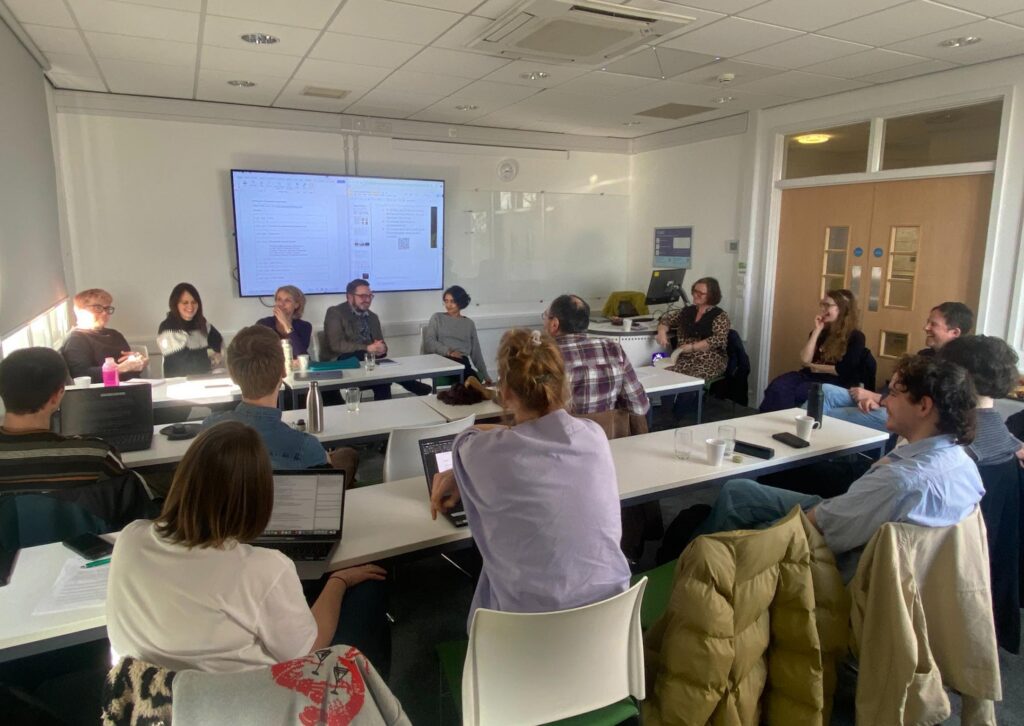
We invited five external speakers to each deliver 10-minute lightning talks on their research; and how that relates to ideas of ‘mutualism’ in animal-human relations. The speakers gave insightful and thought-provoking talks, each examining mutualism through a different lens. Together, they set the tone for a project that seeks not to celebrate frictionless coexistence, but to interrogate how mutualism is framed, mobilised and contested in practice. The speakers challenged simplistic notions of mutual benefit and called for more careful, nuanced analysis of multispecies relationships.
Prof Erica Fudge used historical beekeeping to question whether mutuality is possible when animals appear in archives only as property; Dr Rich Gorman critiqued the pharmaceutical use of horseshoe crabs, arguing that claims of mutual benefit obscure animal harm and deflect ethical scrutiny; Dr Maisie Tomlinson explored how horses in equine – assisted personal development are interpreted as emotionally attuned “prey animals,” raising questions about whose responses count in therapeutic settings; Prof Helen Wilson reflected on fraught urban coexistence with black-legged kittiwakes, highlighting tensions between conservation and nuisance narratives; and Prof Krithika Srinivasan interrogated assumptions about human – dog relationships, suggesting that mutualism often becomes visible only over longer temporal and broader spatial scales. The launch event also marked the start of our recruitment campaign for four 3-year Postdoctoral Research Associates, who will be key to the project’s success.
Find out more about the roles here.